The ants in a North Texas kitchen, wall or lawn could be any of several species, and which one you have decides what to do next. This guide to the types of ants in North Texas sorts seven of them from nuisance to painful, with a drawing of each, the details that give it away, and what to do.
Quick answer
Texas A&M AgriLife calls the pharaoh ant the most commonly occurring indoor ant in Texas, and odorous house ants and little black ants also find their way inside. Outdoors, red imported fire ants sting in swarms, red harvester ants have a powerful sting, pavement ants are often mistaken for fire ants, and carpenter ants nest in trees, wood and wall voids.
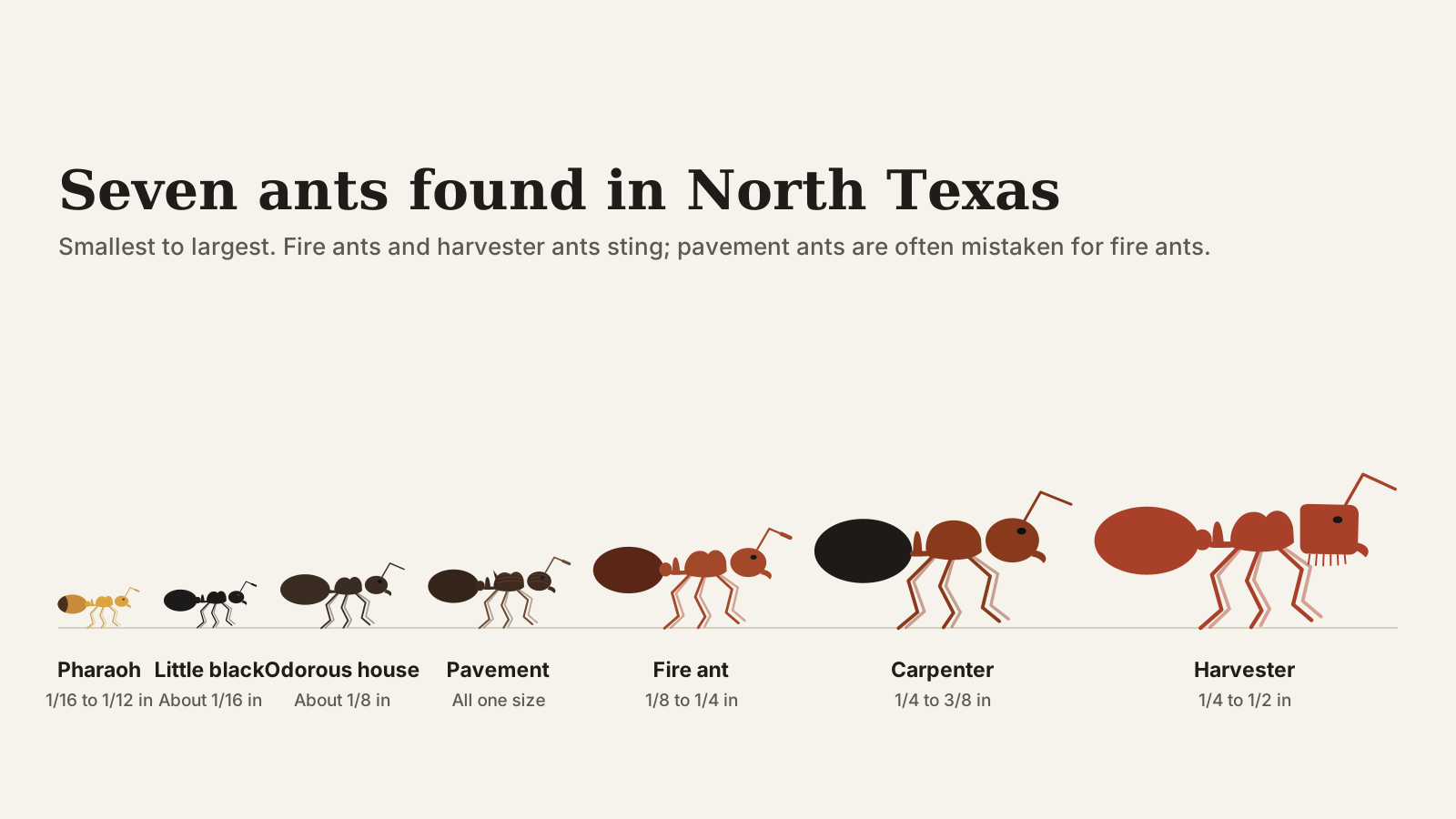
North Texas ants, from nuisance to painful
Nuisance
- Little black ant
- Odorous house ant
- Pavement ant
Hard to clear indoors
- Pharaoh ant
Watch the wood
- Carpenter ant
Painful sting
- Red harvester ant
Stings in swarms
- Red imported fire ant
A rough guide drawn from the descriptions below. Any of them can be worth a call when they keep coming back.
What are you seeing?
- Small dark ants trailing across the kitchen
- Odorous house ants or little black ants. Crush one: a strong rotten-coconut smell means odorous house ants.
- Tiny pale yellow ants in the kitchen or bathroom
- Pharaoh ants. Don't spray them; sprays make the colony split.
- A fluffy mound of soil in the lawn with no hole on top
- Red imported fire ants, especially a few days after a heavy rain.
- Mounds along a sidewalk, and the ants are slow to attack
- Possibly pavement ants, which are often mistaken for fire ants.
- Large ants inside, or small piles of sawdust
- Carpenter ants. Winged ones indoors in late winter or early spring generally mean a nest in the house.
- A bare circle in the yard with one hole in the middle
- Red harvester ants.
Dealing with this right now?
Ants in the kitchen, the walls or the lawn? All Seasons Pest Control will identify them and treat them, across the Mid-Cities and the rest of our Dallas-Fort Worth service area. Estimates are free.
Learn more about our ant control in Euless and DFW.
The seven ants, one by one
Red imported fire ant
Stings, often many times
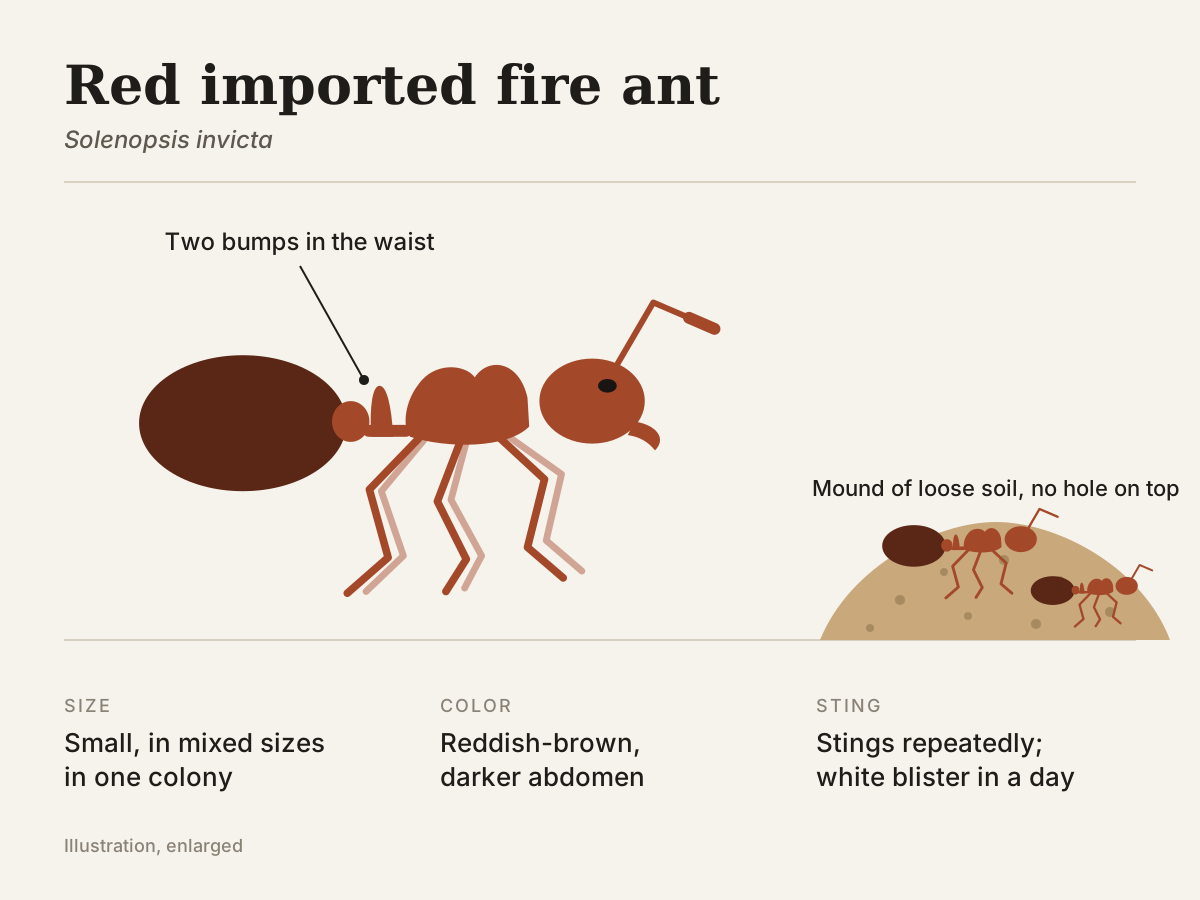
Fire ants are active across North Texas. When NBC 5 found them along a Plano trail in the fall of 2015, Texas A&M AgriLife urban entomologist Mike Merchant explained that rain and cooler weather bring colonies that stayed hidden all summer up toward the surface. Workers are reddish-brown and about 1/8 to 1/4 inch long, and one colony has ants of many sizes, which Texas A&M calls a distinguishing trait; many other ants are all one size.
The mound is fluffy, worked soil with no opening on top, because the ants come and go through tunnels underneath, and it is easiest to spot a few days after a heavy rain. Disturb one and dozens to hundreds of workers crawl up anything vertical, biting and stinging again and again. The sting feels like a burn, and a day or so later a white, fluid-filled blister forms at the spot, something only fire ant venom causes.
They almost always nest outdoors, but they come inside for food and water, especially in late summer. In winter, Merchant said, they look for places that hold heat, such as walkways, utility boxes and houses.
What to do: Keep children and pets away from the mound and don't break it open. Anyone stung who has trouble breathing or severe swelling should get medical care right away. Texas A&M AgriLife recommends a two-step method: bait spread across the whole yard once or twice a year, with August through October a good time for the first round, then treatment of the mounds that still show up. Read more in fire ant control in Tarrant County, or see our ant control for a yard that keeps getting them.
Odorous house ant
Nuisance indoors
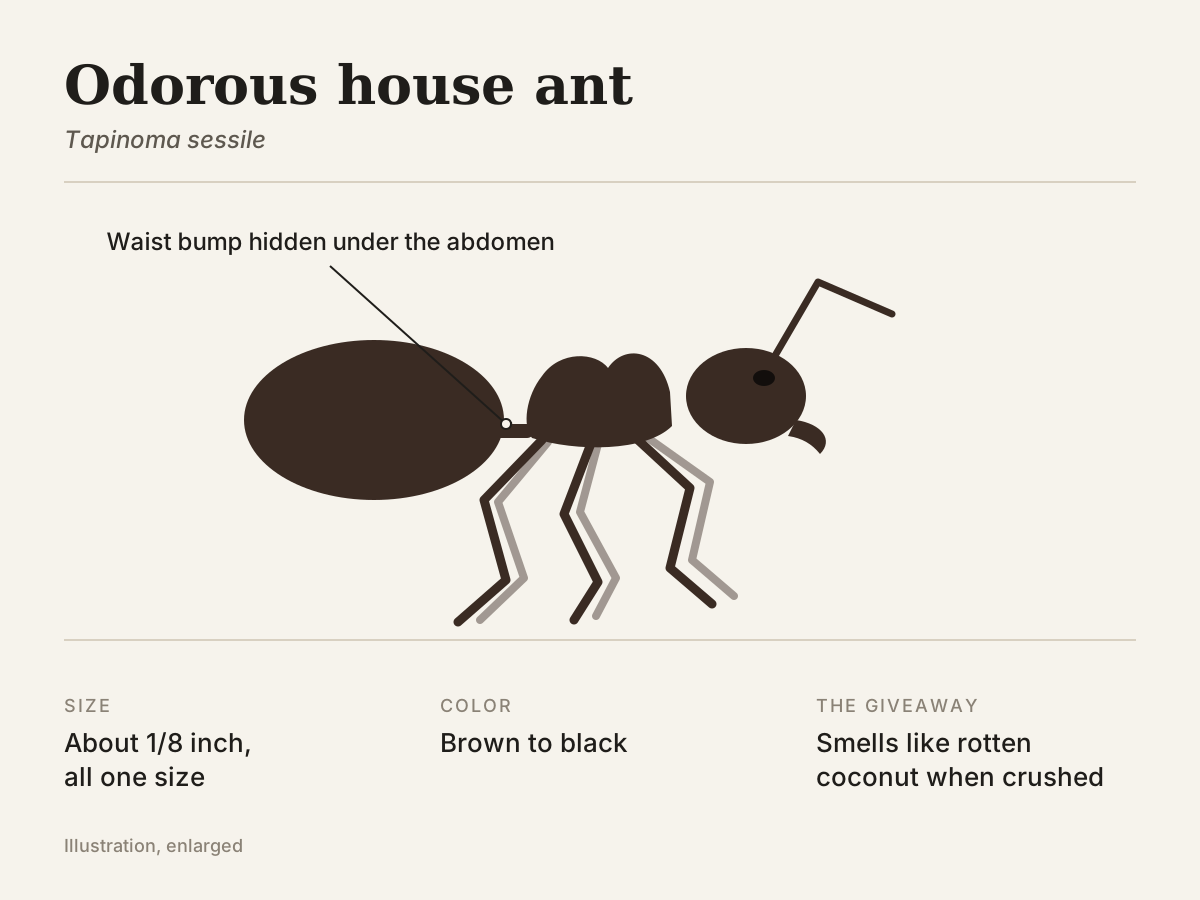
The odorous house ant is native and found across the United States, and NBC 5 reported in 2010 that it had begun turning up in Dallas-Fort Worth homes a few years earlier. Workers are brown, about 1/8 inch long and all one size, and the single bump in the waist is hidden from above. The quickest check is to crush one: Texas A&M AgriLife describes a pungent smell like rotten coconut.
A colony holds anywhere from a few hundred to 10,000 ants, usually with several queens, and they move their nests often. Outdoors they nest in soil under stones, logs and mulch; indoors they use wall voids and brick. They are drawn to sweets.
What to do: Pull dead leaves and mulch back from the foundation, and check under flower pots and flagstones for nests. Wash their trails off counters with soapy water, which wipes out the scent trail they follow, and seal where they come in. Indoors, Texas A&M AgriLife says a bait is usually a better choice than a spray. If they keep coming back, see ant control in Lewisville, TX or ant control in Euless, TX.
Pharaoh ant
Hard to clear indoors
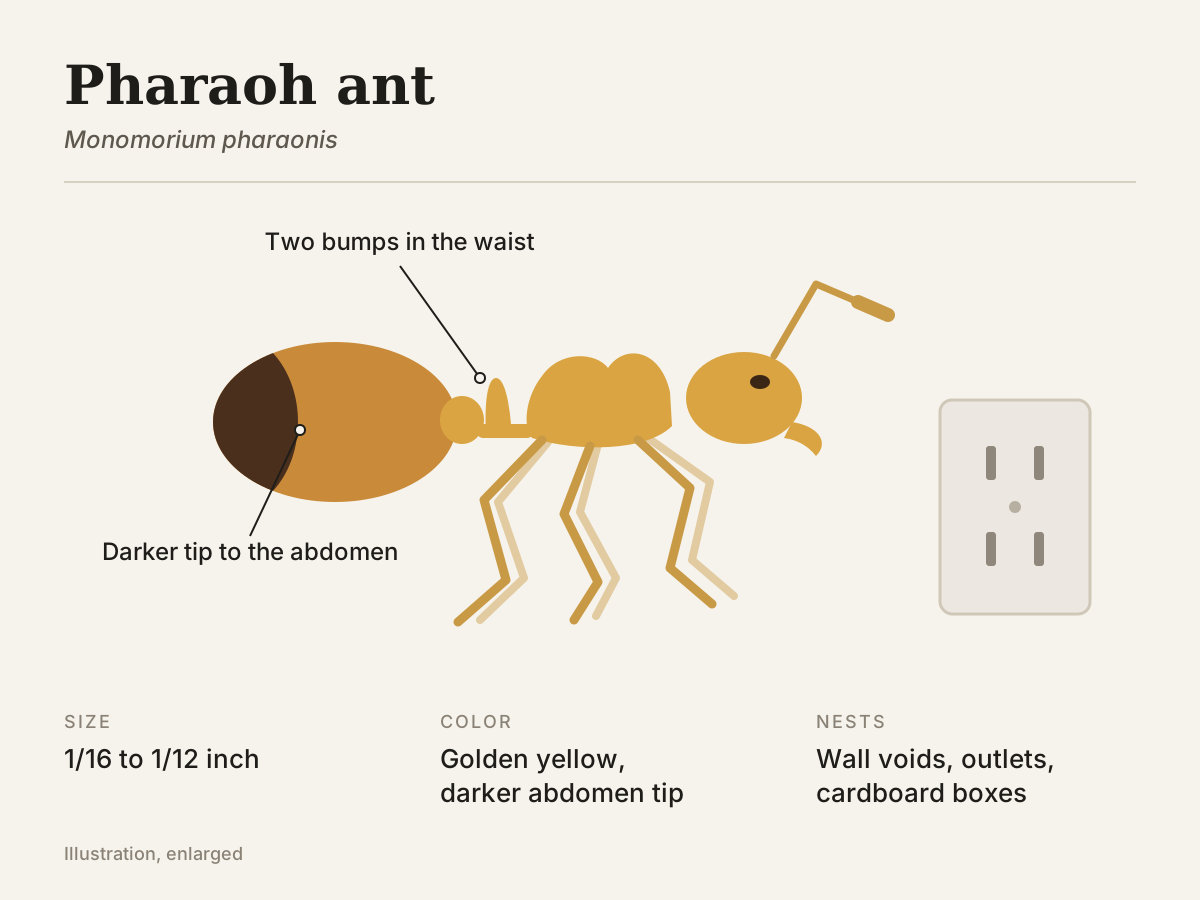
Texas A&M AgriLife calls the pharaoh ant the most commonly occurring indoor ant in Texas, and notes it is sometimes called the sugar ant. It is tiny, about 1/16 to 1/12 inch long, pale yellow to reddish-brown with a darker tip on the abdomen, and it has two bumps in the waist. All the workers are the same size.
Texas A&M says they generally live only in heated buildings, because outside subtropical areas such as southern Texas they can't survive outdoors all year. Indoors they nest in dark, narrow spaces near warmth and water: wall voids, electrical boxes, cardboard boxes. One colony spreads across many nests whose ants move freely between them. They feed on sweets and greasy food, and they don't sting.
What to do: Don't spray them. Texas A&M warns that repellent sprays and dusts make a colony split into more nests, which makes the problem bigger. What works is bait stations placed along their trails throughout the building, checked and replaced until every nest has fed, and a baiting program can take several months. They usually ignore the sugar baits that draw other house ants, so this one is often a job for professional ant control.
Ants in the house or the yard?
All Seasons Pest Control treats ants across the Mid-Cities and the rest of our Dallas-Fort Worth service area. Tell us what you're seeing, and a technician will identify the ant, find the source and treat it.
Carpenter ant
Nests in wood and wall voids
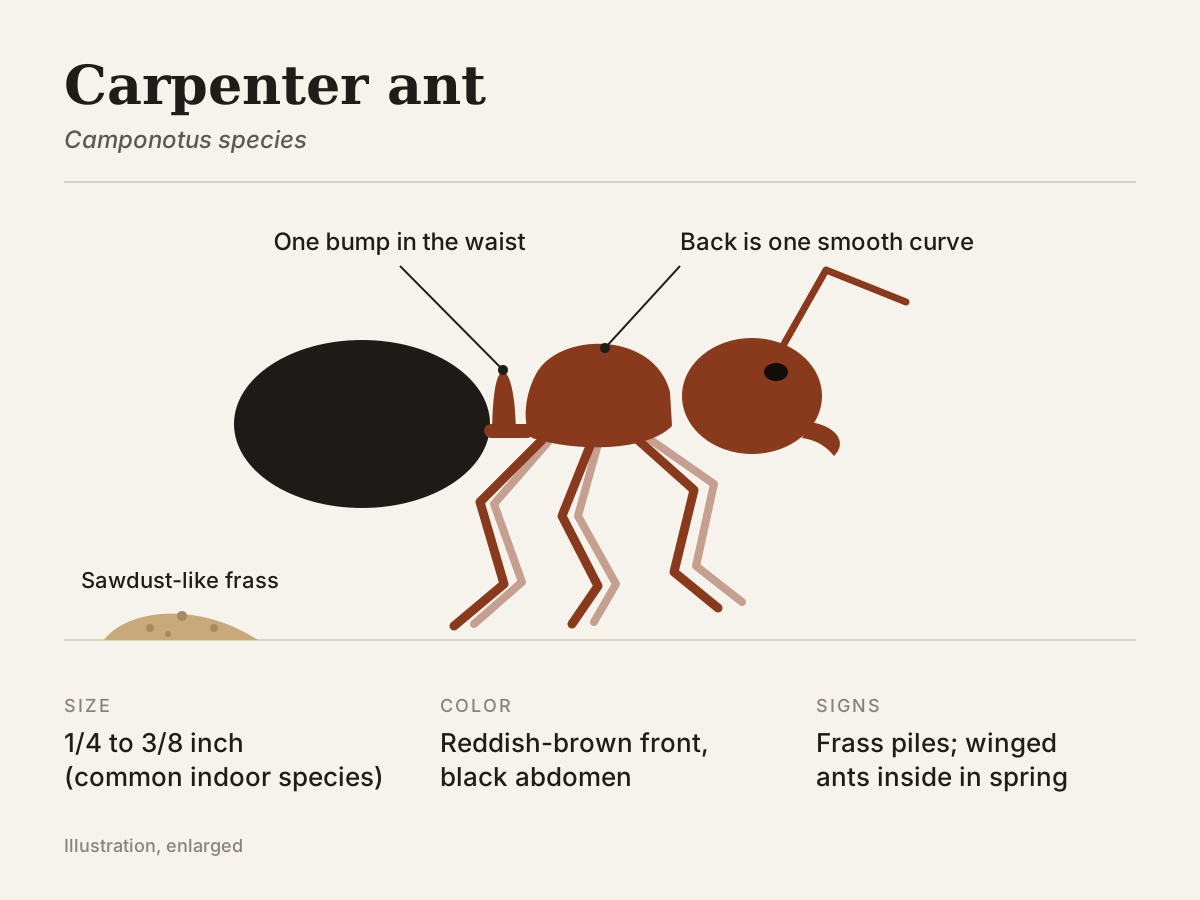
Texas A&M AgriLife calls carpenter ants a common sight around Texas homes throughout the year. They are the big ones: the most common indoor species is 1/4 to 3/8 inch long, with a reddish-brown head and middle and a black abdomen, though other Texas species run from yellow to all black, and workers in one colony vary in size. Seen from the side, the top of the middle section is one smooth curve, and there is a single bump in the waist. They don't sting, but they can bite.
They don't eat wood. Texas species prefer to nest in trees and in hollows that already exist, and indoors they use hollow-core doors, window and door frames, wall voids, insulation and cardboard boxes. Small piles of sawdust-like material pushed out of a small hole mean a nest is close, and winged carpenter ants inside in late winter or early spring generally mean the nest is in the house.
What to do: Follow their trails with a flashlight on a warm night, when they forage most, often along fences, tree limbs and wires. Finding and treating the nest is the surest fix, and fire ant baits don't attract them. Our guide to getting rid of carpenter ants in DFW covers the rest, and a nest inside a wall is a job for ant control.
Little black ant
Nuisance indoors
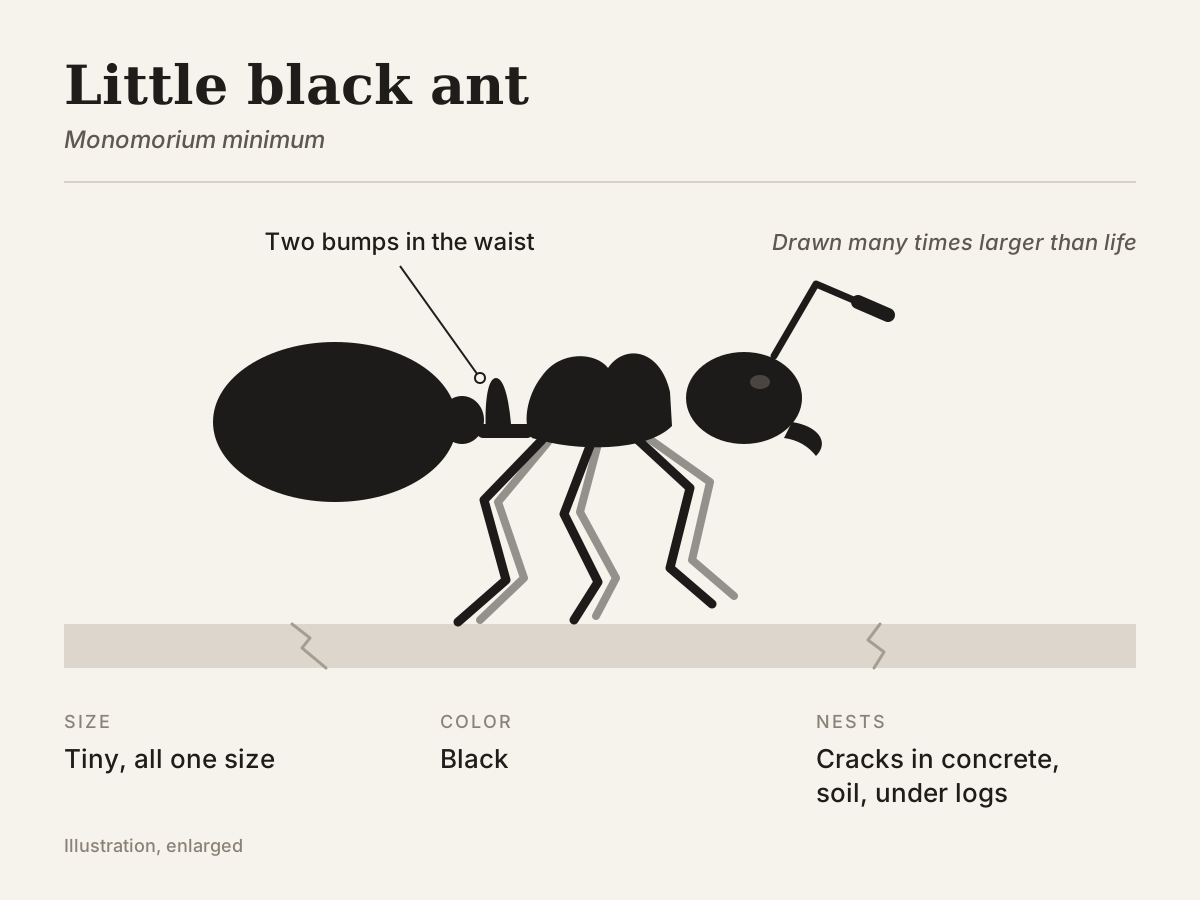
Texas A&M AgriLife lists the little black ant among the native ants Texans find, and notes it is a close relative of the pharaoh ant. It is tiny, about 1/16 inch, shiny black and all one size, and it moves slowly. Its trails, from a few ants to hundreds, often run along sidewalks and foundations.
Outside, colonies nest in soil, leaving small craters of fine soil in a lawn, or under rocks, logs, bark, firewood and stacked brick. Inside they use woodwork, wall voids, masonry and the space under carpet, and they raid pantries and food cabinets. A colony has up to about 2,000 workers and many queens. They eat other insects and the honeydew aphids leave on plants, and they prey on young fire ant queens.
What to do: Texas A&M's advice is to look inside and out for every nest, clear away litter and anything they can nest under, and seal cracks in exterior walls where they get in. Colonies around a house are usually not large, so a few targeted treatments or baits along their trails often handle them. If they keep coming back, we can help.
Pavement ant
Often mistaken for fire ants
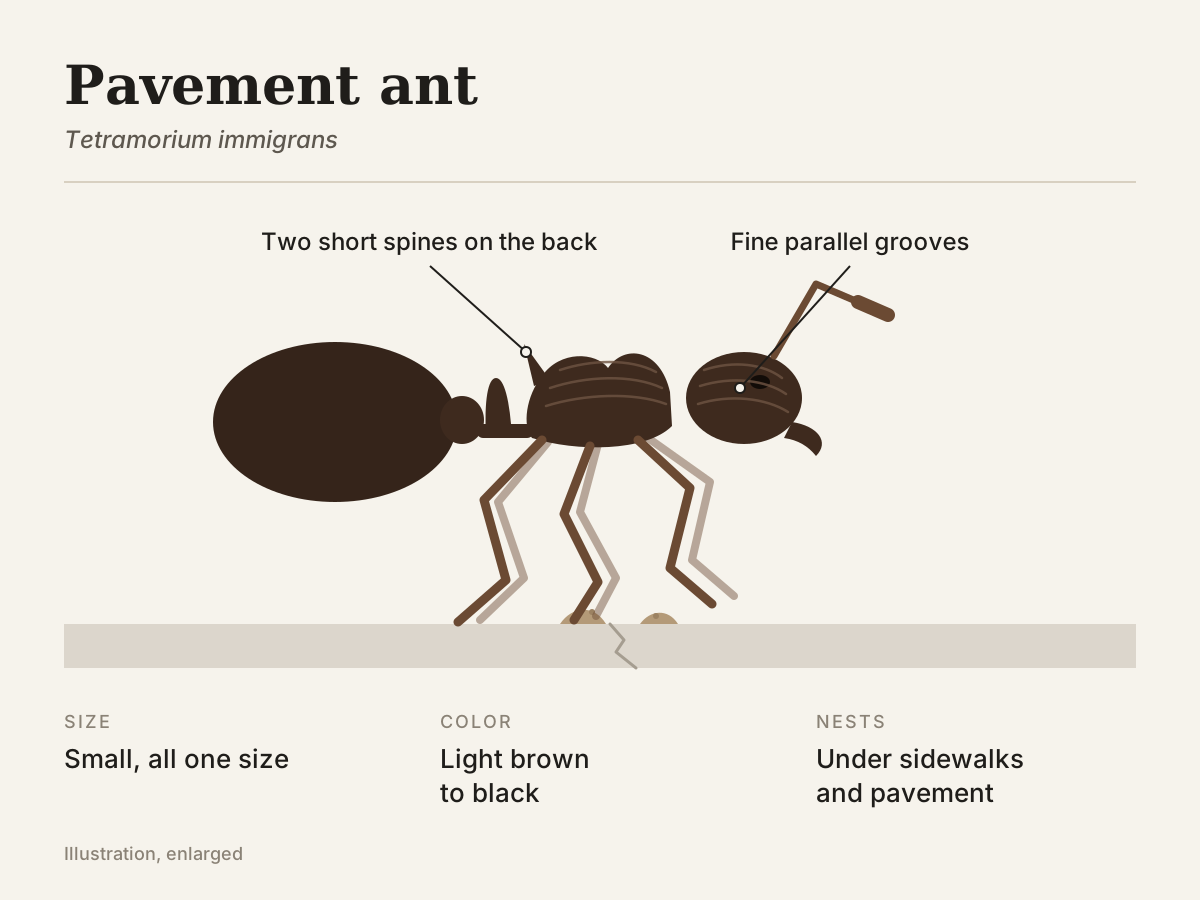
The pavement ant takes its name from where it likes to nest: open, well-drained, gravelly soil like the ground under sidewalks and pavement. It came to the U.S. from Europe. Workers run from light brown to black, every worker in a nest is the same size, and up close there are two small bumps in the waist and two small spines on the back of the middle section.
An entomologist writing on Insects in the City, a blog for Texas pest professionals, describes a Dallas-area home with a stubborn fire ant problem whose mounds turned out to belong to pavement ants, and suspects the ant is more common in Texas than people realize because it gets mistaken for fire ants. The giveaway is behavior: disturb the mound and pavement ants are slower and less aggressive than fire ants.
What to do: Look closely before you treat a mound. Ants that are all one size and don't pour out to attack point to pavement ants, not fire ants, and knowing which one you have decides which bait will work. If you're not sure, contact us and we'll identify it.
Red harvester ant
Painful sting
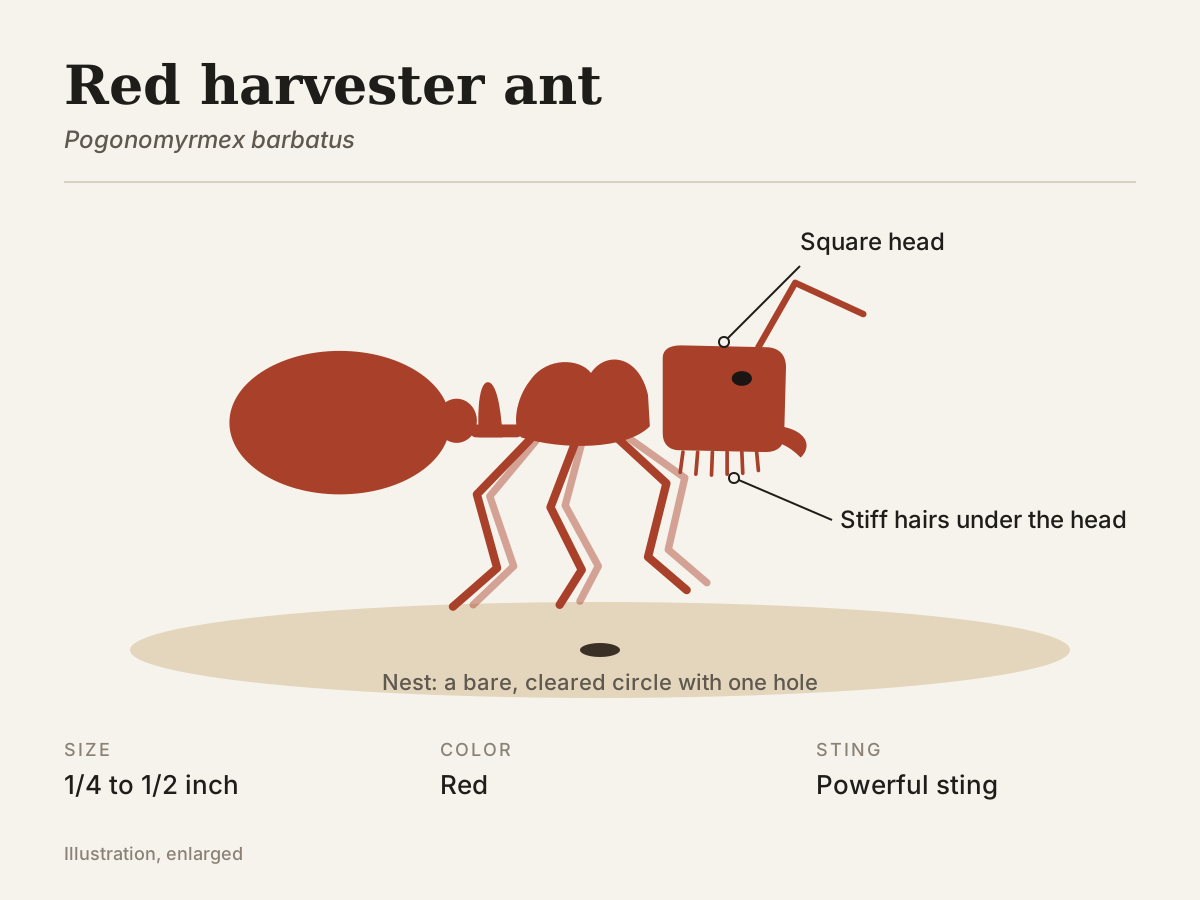
Big, red ants, larger than fire ants, with a row of stiff hairs under the head that they use to carry loads. Most workers are about the same size. Texas A&M gives their range as Kansas and Oklahoma through western Texas into Mexico, and lists them among the native ants Texans find.
You'll know the nest: a bare, cleared circle of coarse soil with one hole in the middle and no mound. Texas A&M puts the cleared area at about 12 feet across on average, anywhere from 3 to 35 feet. They store seeds, scavenge dead insects, and are food for the Texas horned lizard. They have a powerful sting that can be dangerous to sensitive people, and Texas A&M notes that people playing on lawns and in parks near a nest are often the ones who get stung.
What to do: Keep children and pets off the cleared circle. Texas A&M AgriLife calls the red harvester ant seldom harmful, so a nest well away from where people walk or play is less of a concern than one beside the swing set. If a nest sits where people walk or play, we can treat it.
Keeping ants out of the house
Ants follow scent trails to food and water. Texas A&M AgriLife's household advice starts with washing trails off hard surfaces with soapy water, which breaks the trail, and sealing the gaps where ants come in. Outside, pull dead leaves and mulch back from the foundation and clear away litter and anything ants can nest under.
Indoors, a bait is usually a better choice than a spray, because workers carry it back and share it with the rest of the colony. Match the bait to the ant: Texas A&M notes that pharaoh ants and carpenter ants usually ignore the sugar baits that draw other house ants, and fire ant baits don't attract carpenter ants. Our guide to ant control in Tarrant County goes further into why the species decides the treatment.
When to call for help
Texas A&M AgriLife's advice is that if your own treatment hasn't worked within about a week, it's time to call a professional. That goes double for fire ants in a yard where children play, carpenter ants inside the walls, and pharaoh ants, which take a planned baiting program to clear. If you're not sure which ant you have, contact us and we'll identify it, or see ant control.
Related
Sources
- Texas A&M AgriLife Extension: How can I tell if I have fire ants?
- Texas A&M AgriLife Extension: What kind of ant is this? (native ants of Texas)
- Texas A&M AgriLife Extension: Identifying household ants (ENT-2013)
- Texas A&M AgriLife Extension: Carpenter ants around homes (ENT-2001)
- Texas A&M AgriLife Extension, Insects in the City: When ants invade (2018)
- Texas A&M Urban and Structural Entomology: Odorous house ant
- Texas A&M Urban and Structural Entomology: Pharaoh ant
- Texas A&M Urban and Structural Entomology: Little black ant
- Texas A&M Urban and Structural Entomology: Red harvester ant
- Insects in the City: Pavement ant gets a new name (2020)
- NBC 5 Dallas-Fort Worth: Watch your step, fire ants invading North Texas (2015)
- NBC 5 Dallas-Fort Worth: Fire ant mounds surface after recent rains (2018)
- NBC 5 Dallas-Fort Worth: Tiny, stinky ants preparing for big invasion (2010)